The Product Leaders Maturity Model
Understand what delivery challenges are really pointing to.
The Product Leaders Maturity Model helps product organizations understand how effectively they are set up to develop, manage, and evolve digital products. It provides a structured view of organizational maturity across process, structure, and culture and creates a clear basis for focused development.
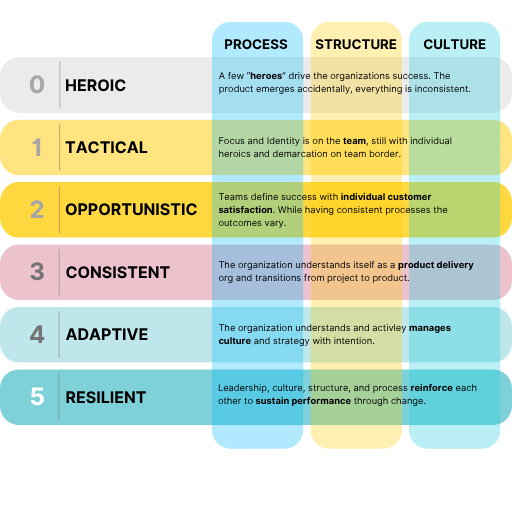
Three Domains. One System.
Our model is built around three overlapping domains: Process, Structure and Culture. These domains cannot be separated in practice: Strong processes without the right culture do not hold. Structural changes without alignment often create new friction. Sustainable progress happens when all three are addressed together.
Process
The process domain focuses on how product-related work is actually carried out in practice.
- How teams work and what they rely on
- What they focus on
- Consistency of processes and outcomes
- How transparent work is made
- Balancing demand and delivery capability
- Which and how metrics are used
- How planning and forecasting happen
- How priorities are set
- How decisions are made
- How policies are applied
- How dependencies are managed
- Agile practices, principles, and patterns
Structure
The structure domain looks at how the organization is set up to support effective digital product work.
- Distribution of skills
- Development of capabilities
- Responsibility and accountability
- Where decisions are made
- Clarity of product or service vision
- Goal setting
- Strength of product or service strategy
Culture
The culture domain focuses on observable behavior and behavioral patterns within the organization.
- Collaboration
- Identity
- Communication patterns
- Conflict management
- Psychological safety
- Leadership styles and behaviors
- Mindset
- Accountability
- Organizational learning
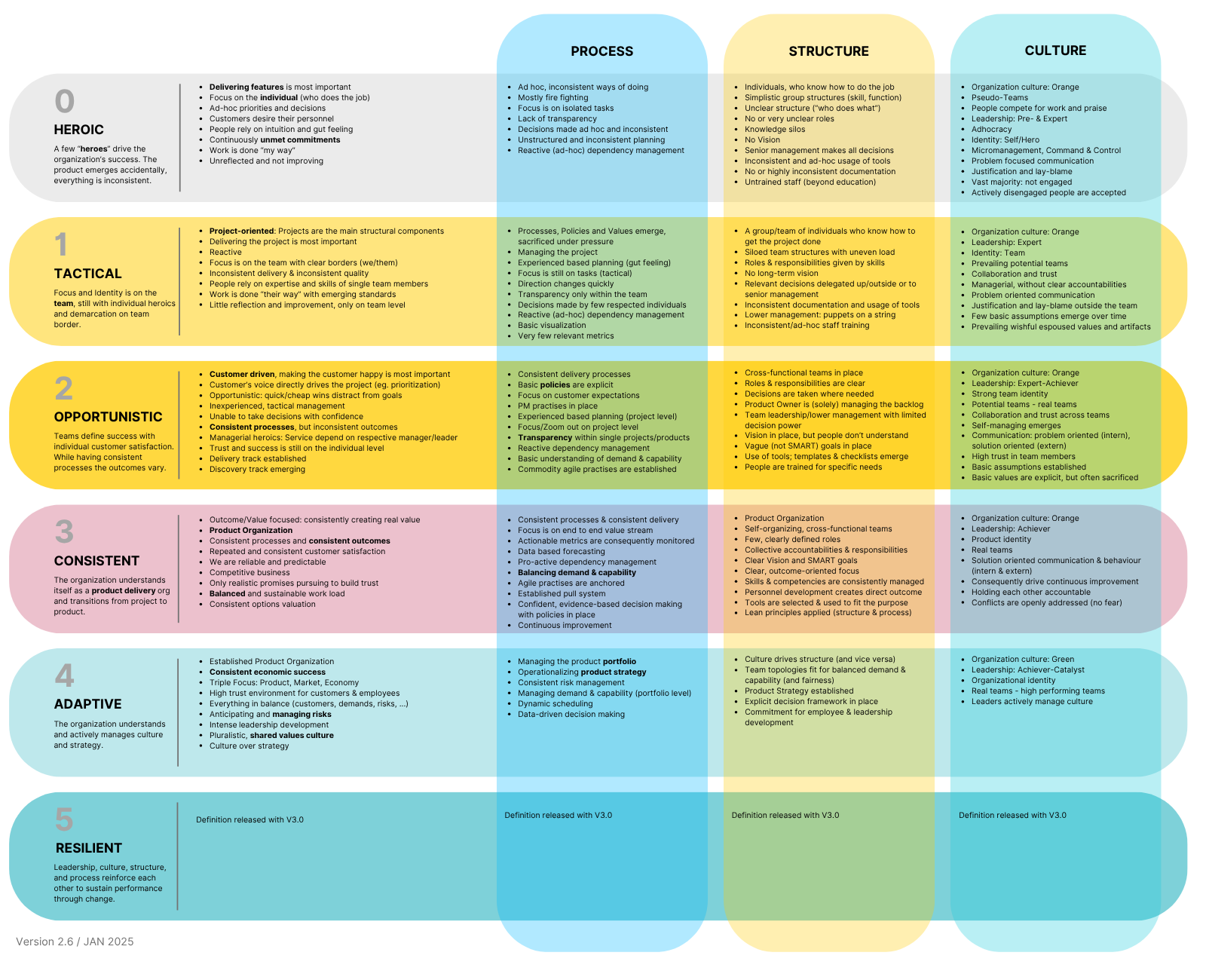
Six levels of product organizational maturity.
Specifically designed for product organizations and those undergoing transformation, the model describes six distinct maturity levels, each defined by observable patterns in how people think, collaborate, decide, and deliver. Click image to download a high-resolution PDF version
© 2022-2026 by Product Leaders Consulting GmbH, licensed under Creative Commons license
CC BY-SA 4.0


Level 0: HEROIC
A few “heroes” drive the organization's success. The product emerges accidentally, everything is inconsistent.
Delivering features is most important; focus is on the individual, who does the job. Priorities and decisions are ad-hoc, people rely on intuition and gut feeling. Work is done "my way", Customers demand "their" personnel and commitments are continuously unmet. The organization does not reflect on how it works and does not improve.
Process
- Ad hoc, inconsistent ways of doing
- Mostly fire fighting
- Focus is on isolated tasks
- Lack of transparency
- Decisions made ad hoc and inconsistent
- Unstructured and inconsistent planning
- Reactive (ad-hoc) dependency management
Structure
- Individuals, who know how to do the job
- Simplistic group structures (skill, function)
- Unclear structure (“who does what”)
- No or very unclear roles
- Knowledge silos
- No Vision
- Senior management makes all decisions
- Inconsistent and ad-hoc usage of tools
- No or highly inconsistent documentation
- Untrained staff (beyond education)
Culture
- Organization culture: Orange
- Pseudo-Teams
- People compete for work and praise
- Leadership: Pre- & Expert
- Adhocracy
- Identity: Self/Hero
- Micromanagement, Command & Control
- Problem focused communication
- Justification and laying blame
- Vast majority: not engaged
- Actively disengaged people are accepted
Level 1: TACTICAL
Focus and identity are on the team, still with individual heroics and demarcation on team border.
Projects are the main structural components of work and delivering the project is most important. The focus is on the team with clear borders (we/them). Delivery and quality are inconsistent, people rely on expertise and skills of single team members. Work is done “their way” with emerging standards, but mostly reactive. Little reflection and improvement, only on team level.
Process
- Processes, Policies and Values emerge, sacrificed under pressure
- Managing the project
- Experience-based planning (gut feeling)
- Focus is still on tasks (tactical)
- Direction changes quickly
- Transparency only within the team
- Decisions made by few respected individuals
- Reactive (ad-hoc) dependency management
- Basic visualization
- Very few relevant metrics
Structure
- A group/team of individuals who know how to get the project done
- Siloed team structures with uneven load
- Roles & responsibilities given by skills
- No long-term vision
- Relevant decisions delegated up/outside or to senior management
- Inconsistent documentation and usage of tools
- Lower management: puppets on a string
- Inconsistent/ad-hoc staff training
Culture
- Organization culture: Orange
- Leadership: Expert
- Identity: Team
- Prevailing potential teams
- Collaboration and trust
- Managerial, without clear accountabilities
- Problem oriented communication
- Justification and laying blame outside the team
- Few basic assumptions emerge over time
- Prevailing wishful espoused values and artifacts
Level 2: OPPORTUNISTIC
Teams define success with individual customer satisfaction. While having consistent processes the outcomes vary.
The organization is customer driven, making the customer happy is most important. The customer's voice directly drives the project (e.g. prioritization), but quick/cheap wins distract from goals set out earlier. Trust and success are still on the individual level. Management is mostly tactical and unable to make decisions with confidence, delivery depends on managerial heroes. The organization has a well established delivery track, discovery track is emerging.
Process
- Consistent delivery processes
- Basic policies are explicit
- Focus on customer expectations
- PM practices in place
- Experience-based planning (project level)
- Focus/Zoom out on project level
- Transparency within single projects/products
- Reactive dependency management
- Basic understanding of demand & capability
- Commodity agile practices are established
Structure
- Cross-functional teams in place
- Roles & responsibilities are clear
- Decisions are taken where needed
- Product Owner is (solely) managing the backlog
- Team leadership/lower management with limited decision power
- Vision in place, but people don’t understand
- Vague (not SMART) goals in place
- Use of tools; templates & checklists emerge
- People are trained for specific needs
Culture
- Organization culture: Orange
- Leadership: Expert-Achiever
- Strong team identity
- Potential teams - real teams
- Collaboration and trust across teams
- Self-managing emerges
- Communication: problem oriented (internal), solution oriented (external)
- High trust in team members
- Basic assumptions established
- Basic values are explicit, but often sacrificed
Level 3: CONSISTENT
The organization understands itself as a product delivery organization and transitions from project to product.
The focus is on outcome/value and the organization is consistently creating real value, has consistent processes and outcomes as well as repeated and consistent customer satisfaction. Business is competitive and delivery is reliable and predictable, promises are based on evident data pursuing to build trust. Teams experience a balanced and sustainable work load.
Process
- Consistent processes & consistent delivery
- Focus is on end to end value stream
- Actionable metrics are consequently monitored
- Data based forecasting
- Pro-active dependency management
- Balancing demand & capability
- Agile practices are anchored
- Established pull system
- Confident, evidence-based decision making with policies in place
- Continuous improvement
Structure
- Product Organization
- Self-organizing, cross-functional teams
- Few, clearly defined roles
- Collective accountabilities & responsibilities
- Clear Vision and SMART goals
- Clear, outcome-oriented focus
- Skills & competencies are consistently managed
- Personnel development creates direct outcome
- Tools are selected & used to fit the purpose
- Lean principles applied (structure & process)
Culture
- Organization culture: Orange
- Leadership: Achiever
- Product identity
- Real teams
- Solution oriented communication & behavior (internal & external)
- Consequently drive continuous improvement
- Holding each other accountable
- Conflicts are openly addressed (no fear)
Level 4: ADAPTIVE
An established product organization that understands and actively manages culture and strategy.
The organization focuses on product, market, and economy at the same time, anticipates and manages risks, and has a high trust environment for customers and employees, where everything is in balance, resulting in consistent economic success. Culture is more important than strategy, leadership development is integrated and holistic to ensure a pluralistic, shared values culture.
Process
- Managing the product portfolio
- Operationalizing product strategy
- Consistent risk management
- Managing demand & capability (portfolio level)
- Dynamic scheduling
- Data-driven decision making
Structure
- Culture drives structure (and vice versa)
- Team topologies fit for balanced demand & capability (and fairness)
- Product Strategy established
- Explicit decision framework in place
- Commitment for employee & leadership development
Culture
- Organization culture: Green
- Leadership: Achiever-Catalyst
- Organizational identity
- Real teams - high performing teams
- Leaders actively manage culture
Level 5: RESILIENT
Leadership, culture, structure, and process reinforce each other to sustain performance through change.
As our Maturity Model is based on real experience and observation from our work with clients, details on this level are currently in internal review. We will publish it with version 3 of our model in a few months.
Understand your current maturity level!
The Product Leaders maturity assessment helps you understand where your organization is today and what would be the most effective next steps to take.
We use our own cookies as well as third-party cookies on our websites to enhance your experience, analyze our traffic, and for security and marketing. Select “Accept All” to allow them to be used. Read our Cookie Policy.