The Product Leaders Maturity Assessment
Understand how mature your organization is in creating the conditions for successful digital product work.
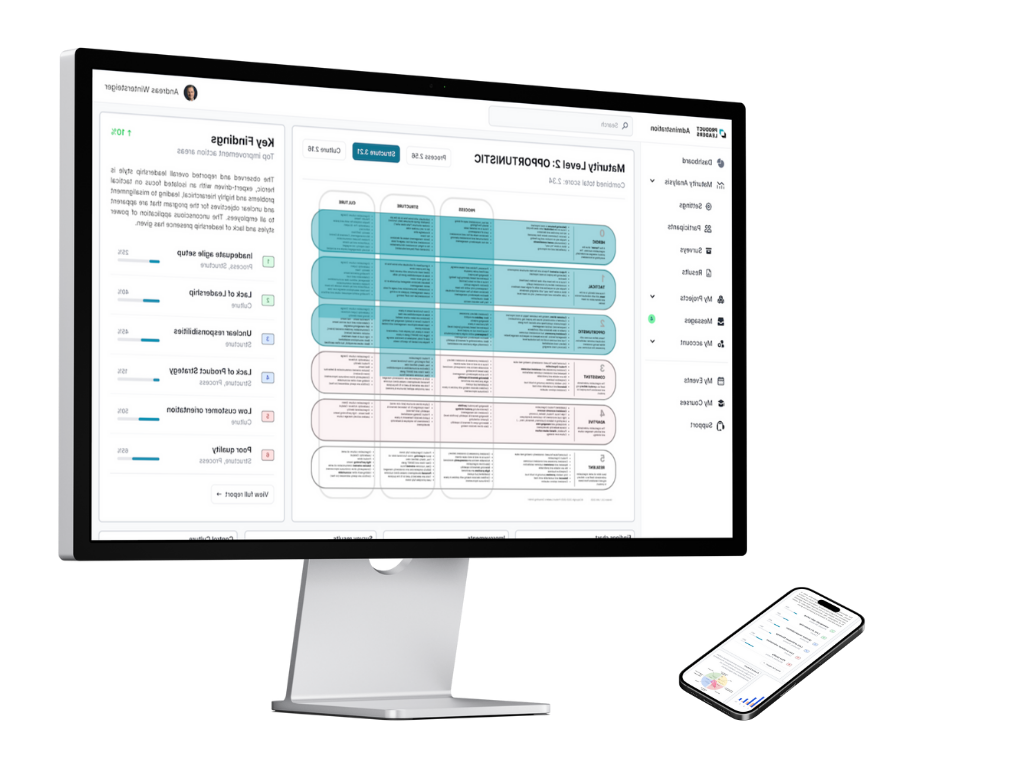
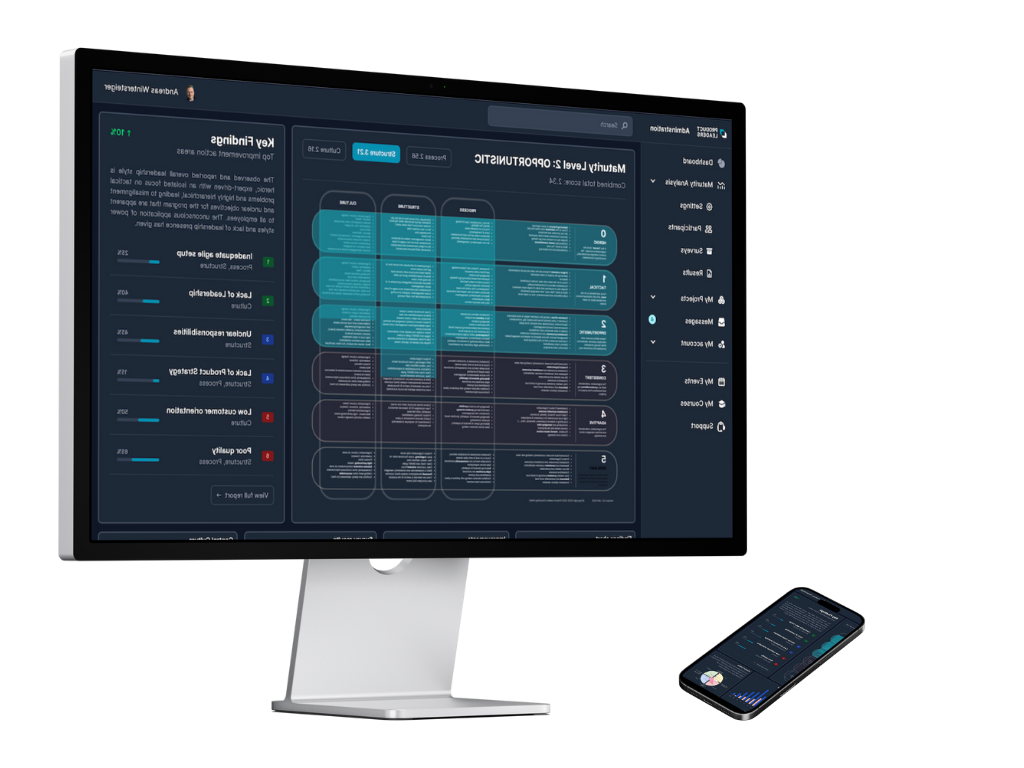
Why we do it
Creating a shared understanding of how effectively an organization is set up to develop, manage, and evolve digital products as a starting point for focused organizational development.
Part of our consulting approach
The assessment is an essential part of our consulting approach, which we call 'Context Setting'. Together with you, we select the participants to include in the assessment from different roles, responsibilities, and viewpoints across the organization. This matters because organizational maturity cannot be understood from a single perspective alone. Typically this includes:
- Team members including developers, designers, architects, etc.
- Team leads, line managers and other leadership roles
- Middle management/leadership
- Senior management/leadership
- Customers and users
- Other relevant stakeholders
The assessment includes a structured questionnaire tailored to the person's role in the organization and a personal interview.
Assessing the organization
It does not assess the maturity of a product, but the maturity of the organization behind digital product delivery. The model helps create a shared understanding of the current state and reveals where further development will have the greatest impact.
6 Levels and three domains
Our analysis covers three core domains: Process, Structure and Culture across six maturity levels.
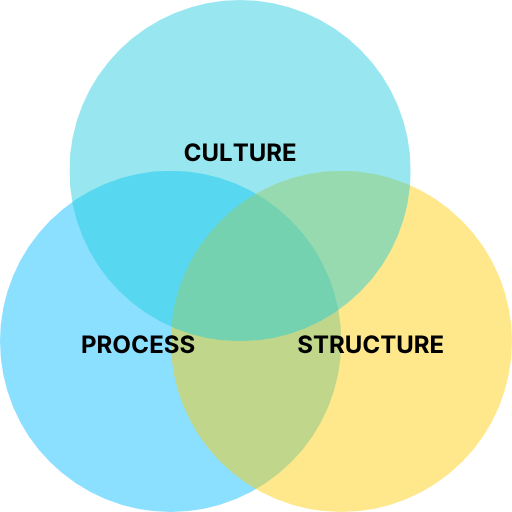
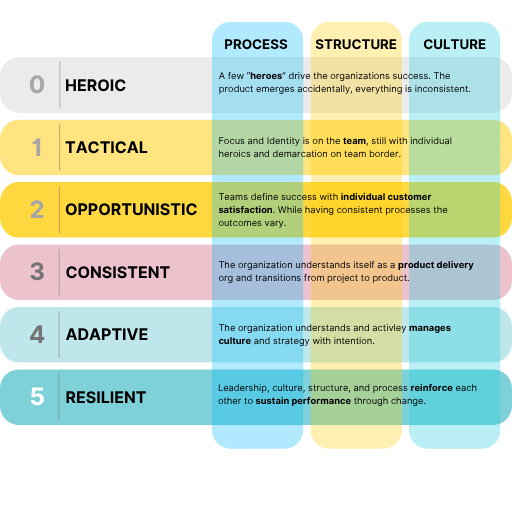
The Product Leaders Maturity Model © 2022-2026 by Product Leaders Consulting. The Maturity Model is licensed under Creative Commons license
CC BY-SA 4.0


What we assess
Our assessment is conducted in three parts, one for each domain. Participants receive an invitation to a questionnaire adapted to their respective role and a personal interview.
Process
The process domain focuses on how product-related work is actually carried out in practice.
- 14 aspects with up to 121 questions
- Questions are specific to role
- Closed questions with a Likert scale
- Space for open-ended responses
The process domain covers topics such as:
- How teams work and what they rely on
- What they focus on
- Consistency of processes and outcomes
- How transparent work is made
- Balancing demand and delivery capability
- Which and how metrics are used
- How planning and forecasting happen
- How priorities are set
- How decisions are made
- How policies are applied
- How dependencies are managed
- Agile practices, principles, and patterns
Structure
The structure domain looks at how the organization is set up to support effective digital product work.
- 7 aspects with up to 59 questions
- Questions tailored to role
- Closed and open-ended responses
- Inspection artifacts, policies, etc.
The structure domain covers areas such as:
- Distribution of skills
- Development of capabilities
- Responsibility and accountability
- Where decisions are made
- Clarity of product or service vision
- Goal setting
- Strength of product or service strategy
This helps us understand how responsibilities, capabilities, direction, and decision rights support or limit product success.
Culture
The culture domain is explored through both a survey and personal interviews with participants in the assessment.
- 12 aspects with up to 37 questions
- Questions tailored to role
- Personal interview by a coach
- Formal statements about culture
Unlike the quantitative parts of the assessment, the qualitative part is based on a small number of open questions that are explored further depending on the answers given.
At its core, the interview looks at two things:
- The organization's formal statements about culture: what it says it stands for and aims to achieve.
- The organization's implicit cultural assumptions: the norms, beliefs, and unwritten rules that shape decisions and behavior in everyday work.
This helps us understand the lived reality behind formal structures and processes.
Connecting the dots
A core part of the interviews is what we call Connecting the Dots: We examine how the findings across all domains fit together.
- Do the perspectives shared in the interviews match the results from the process and structure questionnaires?
- Where do they reinforce each other? Where do they differ?
- What tensions, contradictions, or blind spots become visible?
- We also explore how the organization deals with conflict: Are conflicts addressed openly? Avoided? Escalated? Silenced?
This part of the assessment is especially valuable because it creates a protected space in which people can name things as they are. We deliberately aim to include voices that bring a critical perspective and raise issues they want to see changed in the organization. These perspectives are essential for building a more complete and honest picture of organizational reality.
How the assessment works
We usually begin with the questionnaires sent out in sequence of domains rather than all at once. This makes participation more manageable, since the assessment requires time and attention from the people involved.
Time commitment
We designed the assessment to be thorough, while still realistic for busy professionals. The typical effort for each domain per participant is:
- Process: 60 to 90 minutes
- Structure: about 60 minutes
- Culture: 30 minutes + 40 minutes interview
Progress of questionnaire completion is visible to administrators of the organization.
Interview quality
Interviews are not only about collecting answers, that's why they are conducted by certified leadership trainers and professional coaches certified by the International Coaching Federation (ICF).
They are able to recognize subtle signals, read between the lines, ask targeted follow-up questions, and surface patterns that would otherwise remain hidden.
Confidentiality
Everything shared in the interviews is treated confidentially. Participants are not quoted by name in the analysis report. Instead, the content is consolidated, anonymized, and detached from individual identities.
This creates the trust needed for candid conversations while ensuring that the findings are embedded in the broader organizational context.
What happens after the assessment?
The Product Leaders Maturity assessment is the starting point for targeted organizational development.
The assessment serves as a baseline for the engagement. Because it is grounded in the Product Leaders Maturity Model, it helps us derive focused measures that enable the organization to move toward the next level of maturity.
- Comprehensive analysis report
- Practical foundation for prioritizing action
- Meaningful and context-specific insights
Many organizations choose to repeat the assessment after a certain period to see where improvements have been achieved and which areas still require further attention. This provides an evidence-based view of organizational development.
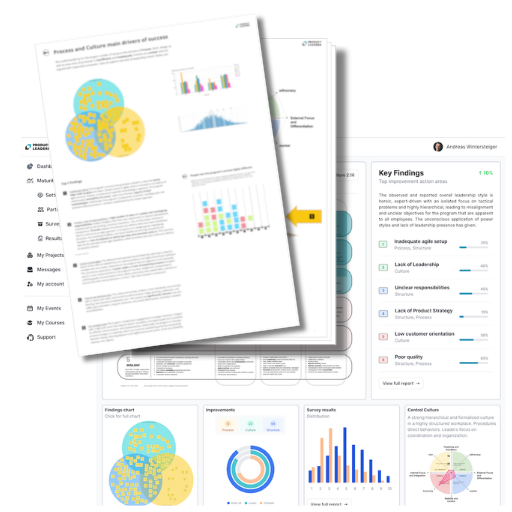
The Product Leaders maturity assessment helps organizations understand where they stand today, what patterns shape their current reality, and what needs to change to move forward with greater clarity and impact.
Understand your current maturity.
Define your next step with clarity.
Explore how the Product Leaders Maturity Assessment can help you create a clear picture of your organization's current state and build the foundation for focused development.