Our Approach
Creating clarity. Aligning together. Enabling change.
From relieving pains to unraveling organizational patterns, enabling the true potential to unfold and reach higher maturity levels.
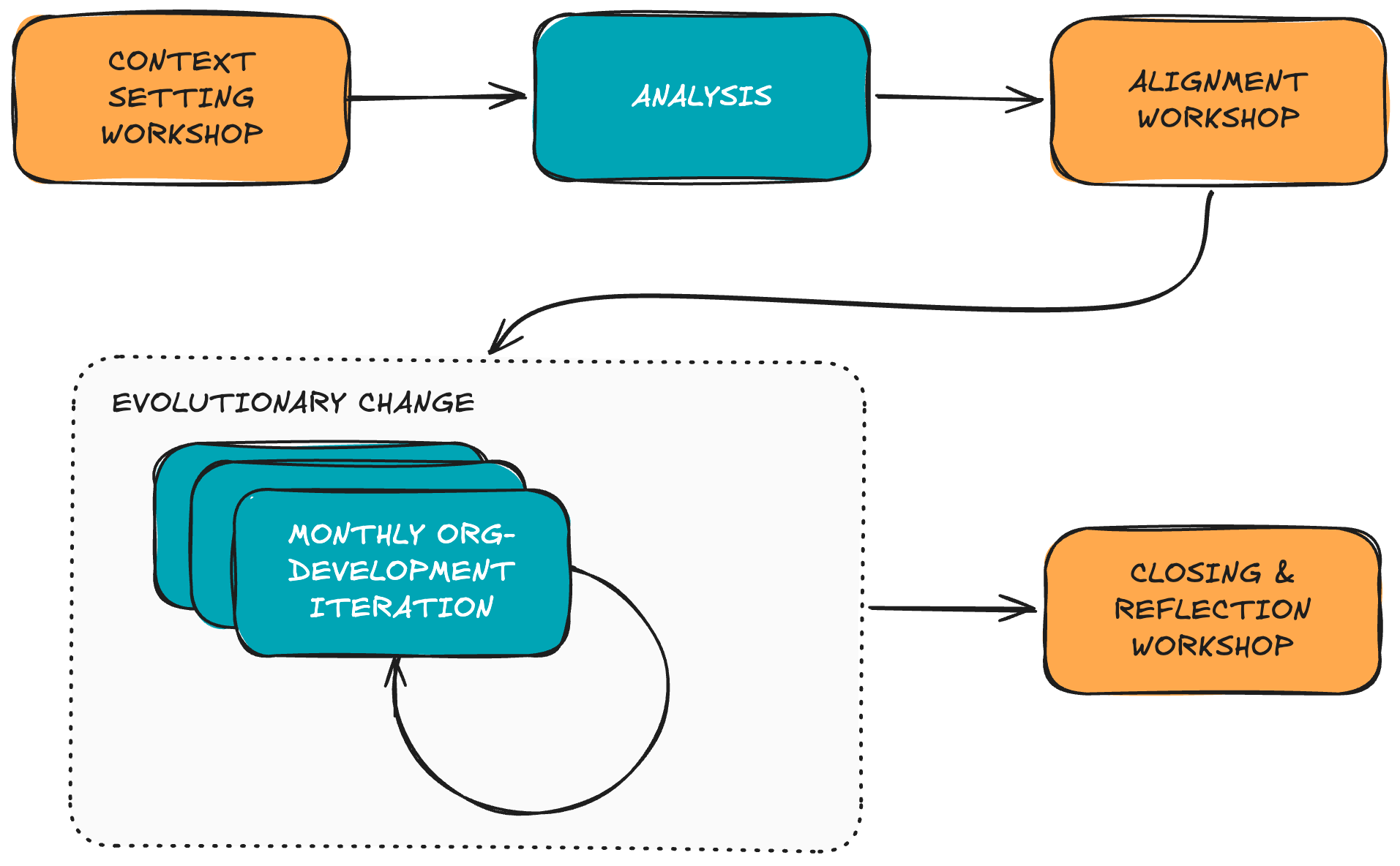
Evolve Maturity through Evolutionary Change
We bring a clear, trusted approach to every engagement, individually crafted for your situation, your challenges, and your goals to create the most meaningful impact.
-
STEP 1 CONTEXT & SCOPE
Context Setting Workshop
Understanding challenges and setting up the work well.
Every effective collaboration starts with thorough scoping. In this step, we clarify the challenge to be addressed, the expectations on both sides, and the conditions needed for effective collaboration. We define how we will work together, who from the leadership team will partner with us, where decision-making authority sits, and what needs to be in place for the work to move forward with focus and clarity.
The leadership team plays a central role from the outset. This is where priorities are set, direction is established, and the conditions for meaningful change are created. By the end of this step, there is a shared understanding of the challenge, the way of working, and whether both sides are ready to move forward together.
-
STEP 2 GETTING CLARITY
Analysis Phase 1
Understanding organizational reality.
We look at the organization from several angles. We review relevant artifacts such as processes, structures, role descriptions, principles, values, meeting formats, and other working materials. In parallel, we run questionnaires and conduct interviews across the organization to understand what cannot be seen in documents alone: communication patterns, tensions, conflict lines, behavioral dynamics, and cultural realities.
Learn more about our approach to organizational analysis
This is where our coaching perspective adds particular value. We listen closely, ask targeted questions, and look beyond visible symptoms to understand the underlying patterns. At the end of analysis, we provide a focused analysis report to a carefully selected group, together with initial recommendations for the next steps.
-
STEP 3 SETTING GOALS
Alignment Workshop
Turning insight into shared direction.
We bring the relevant decision-makers together in a focused alignment workshop, where we review the findings of the analysis, create a vision and sharpen the goals of the collaboration, clarify priorities, discuss risks, and define meaningful next steps. We also revisit the conditions needed for success and ensure there is shared clarity on what the work ahead requires from both sides.
This workshop is especially important because it connects insight with commitment. It creates alignment around what matters most now and helps ensure that the next phase starts with clarity, realism, and shared ownership.
-
STEP 4 ORGANIZATIONAL DEVELOPMENT ITERATIONS
Evolutionary Change Management Phase 2
Guiding change step by step in a complex environment.
Change in complex organizations cannot be fully planned in advance. Too many factors move at the same time, and many dynamics only become visible along the way. That is why we consciously choose an evolutionary approach to change. Together, we define clear next goals and establish cadences in which progress, feedback, risks, and adjustments are reviewed regularly. This provides guidance without being rigid and allows for adjustments whenever needed.
Evolving maturity in short iterations.
On a monthly PDSA cadence, we take action together on planned and prioritized measures. Process and progress are permanently made transparent to all involved parties and serve as a basis for reviews and re-evaluation as well as planning for the next iteration of organizational development. We provide a monthly engagement report with documented insights, recommendations and decisions.
A key success factor is the combination of strong internal change coordination and close collaboration with the leadership team. Evolutionary change needs both: people inside the organization who actively drive the work forward, and leaders who provide direction, address tensions, and enable the decisions needed for real progress. This is how change becomes part of actual organizational development rather than a disconnected initiative.
-
STEP 5 CLOSING THE ENGAGEMENT
Closing and Reflection Phase 3
Looking back, making progress visible, and preparing what comes next.
The final step is a conscious closing phase. Together, we reflect on where the organization started, which measures were taken, what emerged along the way, how we responded to new insights and challenges, and what progress was achieved. This phase includes a final report and a shared reflection on outcomes, learnings, and possible next steps the organization can continue to drive internally. Some clients also choose to conduct a final assessment at this stage to better understand how the change is perceived from within the organization itself.
We also value what often continues beyond the formal end of a project. Many of the leaders we have accompanied through complex change remain in contact with us afterwards. Having worked together through uncertainty, difficult decisions, and real organizational challenges, the relationship often grows into one marked by trust, openness, and mutual respect. We always appreciate hearing how things evolved and what further progress became possible over time.
Change works best in true co-partnering
We see collaboration as real co-creation of change where we meet on eye-level.

Equal Partnership
That means we bring perspective, experience, and methodological clarity, while the organization brings context, ownership, and the internal authority needed to make decisions and support change.
Leadership cannot be delegated
Our work creates the greatest impact when there is a shared direction, openness around relevant developments, and a willingness to address tensions early. That is why close collaboration with the leadership team is essential. Especially in complex environments, progress depends on working with people who can set priorities, make decisions, and actively support deeper change.
Impact
When leadership, internal change responsibility, and external guidance are aligned, change becomes more than a formal initiative. It becomes a realistic and supported path forward.
Explore what collaboration could look like in your context.
Let’s take a first look together at what really needs to be addressed and what a meaningful next step could be.